


Who Was Michel-Eugène Chevreul?
Michel-Eugène Chevreul is one of the great figures of French chemistry. Born in Angers in 1786, he published his first works at the age of 20, focusing on dyes and the action of nitric acid on cork.
Early on, he turned to a field that was still little explored at the time: organic chemistry, particularly the study of the composition of fats. His research led him to write a major work, Chemical Research on Fats of Animal Origin, in which he presented an essential theory on saponification, the reaction that transforms fats into soap and glycerin.
A practical outcome of his work was the development, in 1825, of stearin candles, which burned much cleaner and with less odor than the tallow candles commonly used at the time.
Appointed Director of Dyes at the National Gobelins Manufactory, Chevreul also devoted himself to the study of colors and their applications in the arts. He formulated the famous law of simultaneous contrast, which describes how colors influence and change each other when placed side by side. Presented in 1828, this theory - combining chemistry, optics, and practical experimentation - had a lasting influence on craftsmen (dyers, upholsterers, glassmakers) as well as on artists, particularly Impressionist painters who were sensitive to his work on the light spectrum and the color wheel.
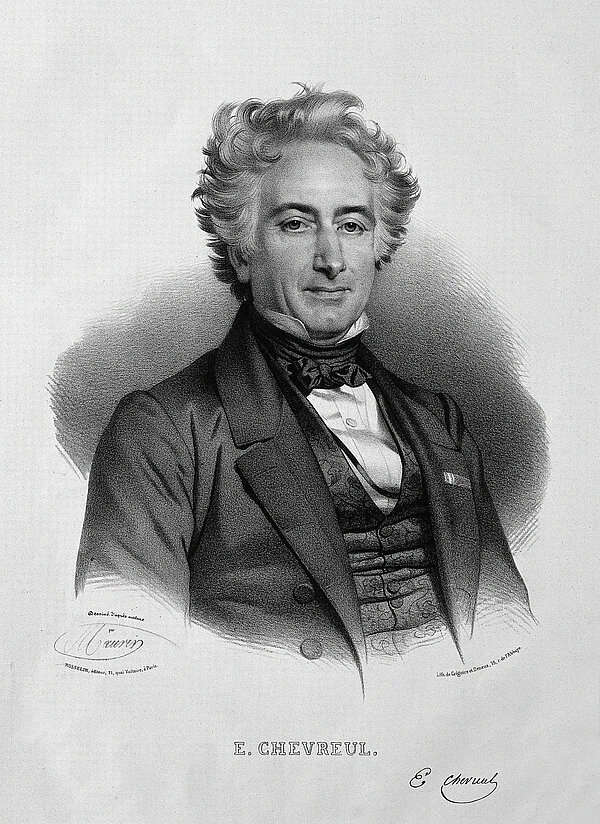

Michel-Eugène Chevreul was elected to the French Academy of Sciences in 1826.
At his death in 1889, at the age of 103, France honored him with national funeral rites. His name is today inscribed on the first level of the Eiffel Tower, alongside 72 other scientists who left a lasting mark on their era: he occupies the 14th position on the north face.