
Over 70 participants attended the EuraMaterials x Institut Chevreul Meeting
On Thursday, January 29, 2026, the Institut Chevreul hosted the EuraMaterials x Institut Chevreul Meeting, bringing together industry professionals, researchers, and experts to discuss key challenges in sustainable chemistry and materials. The morning session highlighted the Institute’s technological platform and showcased the expertise available to support R&D and innovation projects for companies.
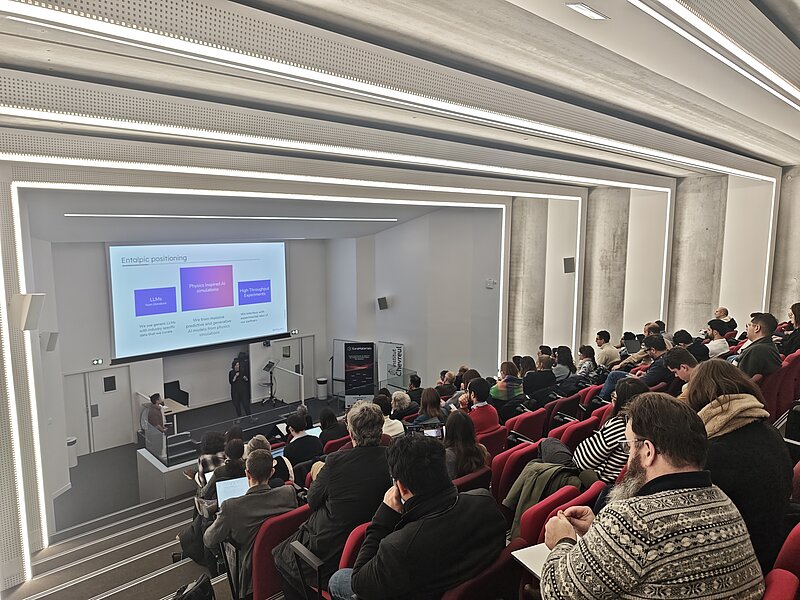
The event aimed to foster synergies between academia and industry and demonstrate how the Institut Chevreul’s tools can address current challenges in sustainability, recycling, and materials innovation.
Spotlight on PTICM: Tools for Industrial Projects
The morning began with presentations by Sophie Reynaud (EuraMaterials) and Hugues Leroux (Institut Chevreul). Sébastien Paul then presented the Technological Platform for Engineering in Chemistry and Materials (PTICM), which brings together equipment and expertise in areas such as recycling, catalysis, and formulation, supporting both research projects and industrial developments.
Recycling and Valorization of Polymers
The first thematic session focused on polymer recycling and valorization:
- POLYREC : Guillaume Corjon highlighted advances in mechanical recycling, depollution, and catalytic pyrolysis to improve the quality of recycled materials and reintegrate them into production cycles.
- TEXTIFLOOR : Thomas Letiers provided an industrial perspective on textile and composite materials, focusing on recyclability, process optimization, and circular material flows.
Towards More Sustainable and Rational Formulation
The next session showcased innovative approaches in sustainable formulation:
- HT-SMARTFORMU : Véronique Rataj demonstrated how robotic acceleration and design-of-experiments can rapidly develop and optimize formulations in a more sustainable way.
- BIORAD : Anne Gilet and Damien Hartmaan presented a project focused on sustainable formulation, integrating both environmental and performance criteria to design, compare, and improve materials and products.
Catalysis and Innovative Materials
The morning concluded with a session on catalysis and materials innovation:
- REALCAT : Egon Heuson presented high-throughput catalytic screening capabilities to explore new pathways efficiently using automated methods.
- ENTALPIC : Nikita Halls shared an innovative approach combining artificial intelligence and chemistry to accelerate R&D and the design of new materials and processes in a faster and more sustainable way.
Collaboration with the Institut Chevreul
Finally, Emmanuelle Wingfield (CNRS Technology Transfer Engineer) explained how companies can collaborate with the Institut Chevreul, presenting available support mechanisms, partnership opportunities, and ways to advance R&D projects. The event concluded with a networking lunch, fostering exchanges, feedback, and the development of future collaborations.
This morning fully achieved its objective: demonstrating how the Institut Chevreul’s platforms and expertise can help test, analyze, validate, and optimize materials projects while addressing sustainability and industrial innovation challenges.