

article publié le 19 May 2025

[Seminar]: “3D ED: A Powerful Tool for Structural Characterization” by Philippe Boullay

Over the past ten years, structural crystallography has undergone a revolution thanks to the introduction of various acquisition and data analysis protocols for electron diffraction using parallel beams. These approaches are collectively referred to as 3D ED (Three-Dimensional Electron Diffraction).

They all aim to reconstruct the reciprocal (3D) lattice of a crystalline compound by collecting electron diffraction (ED) patterns at different goniometer tilt angles.

Performed using a transmission electron microscope, 3D ED allows for the analysis of nanometer-sized single crystals and provides data that enables the determination of the crystal structure of materials on a scale inaccessible by other diffraction techniques.

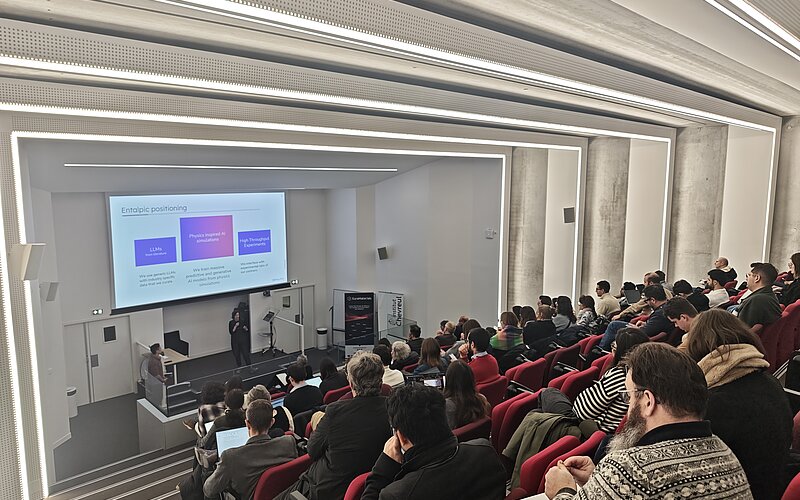
A seminar took place at the Chevreul Institute on Thursday, May 15.

Philippe Boullay, a specialist, was invited to the Chevreul Institute to give a seminar on Thursday, May 15 at 2:30 p.m.

After an introduction to the method, in which Philippe Boullay explained the various available approaches, he illustrated several applications of 3D ED for different types of samples and challenges.

He began with precession-assisted 3D ED, which enables the resolution of complex structures and provides reliable and precise refinements for “stable” compounds, typically in materials science.

Then, he presented continuous rotation 3D ED, which allows data to be collected with a date acquisition time under a minute for “fragile” compounds, typically found in porous materials, pharmacology, and life sciences.

Finally, Philippe Boullay presented some recent instrumental and methodological developments aimed at making this tool even more accessible, versatile, and efficient.

Who is Philippe Boullay?

Philippe Boullay obtained a PhD in materials chemistry in 1997 from the University of Caen, where he worked on the synthesis and structural characterization of transition metal oxides. He then completed postdoctoral research in the Department of Inorganic Chemistry at Stockholm University and at the EMAT laboratory at the University of Antwerp. In 1999, he became a CNRS researcher at the SPCTS laboratory in Limoges, where he studied structure and phase transitions in ferroelectric materials. In 2006, he joined the CRISMAT laboratory in Caen, where he notably promoted and developed the use of electron crystallography for the structural analysis of functional materials.